As the spring descends on us all like an old friend that you haven't seen for a while approaching you from the other side of the grocery store, my thoughts are turning to one thing. Fishing for trout. I know from experience that the early spring can be a great time to catch some nice trout, but I also know that during the early spring timing is everything, especially when you are talking about river fishing for trout.
You see the trout have been lethargic all winter due to the freezing cold water temperatures and during the spring, as the water temperatures rise, the trout begin to feed quite heavily. The problem is that rising temperatures also mean rising water levels due to snow melt, and rivers can become high and muddy quite fast. And high and muddy water make river fishing for trout difficult to impossible, which is where timing comes in.
With any luck you live within close proximity to the rivers you like to fish, so paying attention to the water levels won't be difficult. Here in Northwest Montana, the rivers are usually very fish-able from late March to late April and even into May sometimes. Although the exact weeks vary from year to year. I have found that the biggest thing to keep in mind are the air temperatures at night. I have found that once the air temperatures stop dropping below freezing during the night, the run off will really speed up, which means the rivers will become too high to fish much faster. When the air temperatures stay below freezing at night, the snow in the mountains will melt much less quickly, thus that water won't be flowing into the rivers quite as fast.
This is especially true if you are into drift fishing, as I am. Drift fishing for trout is my favorite activity and the early spring can be quite productive, as long as you get the timing right. Just remember a few simple tips when it comes to early season trout fishing; the clearer the water the better, afternoons and evening are often some of the most productive times of the day during the early spring and watch those temperatures at night. Once they get above freezing, it won't be long until the rivers will become much less suitable to fishing.
Showing posts with label trout fishing. Show all posts
Showing posts with label trout fishing. Show all posts
Tuesday, March 13, 2018

Thursday, September 28, 2017
As The Weather Cools Off The Trout Fishing Is Heating Up. Who Doesnt Love Fall Trout Fishing?
 So I headed down to the same are of the Swan River that I fished last week, but this time rather than walking along the bank down to the really big "hole" I decided to wade straight across the river. You see, I know that there is a nice hole on that side of the river as well, which I figured needed a little attention too. And being on my little "mini jig kick" (which I referred to in my last post) you can imagine what my bait of choice was going to be on this particular day. In case you were wondering, the grainy picture to the right shows you the exact rig.
Once I got across the river and worked my way into casting distance of the hole itself I began to drift fish.After two casts I realized that I needed more weight, so I pinched a single split shot sinker onto my line twelve or so inches above the mini jig. This did the trick, because I began catching rainbows from 8 to 12 inches every other cast or so. I even changed my trout worm color to natural and the hungry rainbow didn't mind a bit! After working my way through the hole I waded down river to the BIG hole.
While the action wasn't as "hot and heavy" as it was upstream I did catch a small trout or two and missed what felt like a very nice one. I then did exactly what I did the prior week. I switched from a Powerbait trout worm body to a Powerbait Power Nymph body. I know, it was just like the prior trip and can you guess what happened?
Once again within a cast or two I felt the familiar "bump, bump", but then a very heavy pull. I set the hook and immediately felt the weight of a large fish. "Oh Jesus", I thought to myself. I figured that this trout didn't realize that he was hooked because judging by the weight, if he made a run, I was in trouble! So I kept reeling in slowly and could feel the monster shaking its head back and forth the whole time. It just wasn't making sense, because a rainbow trout of this weight NEVER behaves like this one was.
I then got the fish close enough to see him and much to my chagrin, it was a lake trout! A five or six pound lake trout, which on my four foot ultralight rod felt like a monstrosity. I reeled the big fella in, unhooked him, then sent him on his way. I then couldn't help but think about was terrible fighters lake trout are! In hindsight, every one that I have ever caught has been just like this they initially bite, then get hooked, and all but roll over, just waiting to be winched in. Oh well, it makes for a decent little story and the rainbows made for a nice little day. All in all a good day on the water without a doubt.
Thursday, September 14, 2017
Sometimes The Trout Fishing Gods Smile Upon You
For the past few weeks, here in Northwest Montana we have been dealing with a very strange phenomenon. There are wild fires burning all around us and the smoke from these fires has been literally choking us every afternoon (and even some evenings). For the past few weeks the air has looked similar to fog, with the difference being that the air smells of a burning camp fire. It is quite annoying and quite unhealthy, but what are you going to do, right? You just have to deal with it and wait for cooler weather and/or rain to help stamp out the fires, thus ending the problem.
Well, with a cold front on the way everyone has been quite excited, hoping that the front would bring with it some much needed rain. While I certainly want nature to give us a hand with the fires, upon hearing this news all I could think was, "I had better get out there and try some trout fishing ahead of this anticipated cold front." You see, the trout fishing is usually pretty good ahead of cold fronts, so even though I didn't have a ton of time, I headed out for a quick fishing trip.
For most of this fishing season I have been on a mini jig kick, using a 1/32 or 1/16 ounce jig head tipped with a Powerbait product (trout worm, nymph, or mouse tail) as bait on almost all of my trout fishing excursions. I still drift fish, just like I always have with the difference being the bait. And while it hasn't been as productive as when I use live worms as my trout bait, it has been plenty successful in it's own right.
So as I worked my way into position at the head of a big hole on the Swan River, I tied on a 1/32 ounce jig, tipped it with a natural colored Powerbait trout worm and began to drift fish. After a few casts I realized That I needed more weight, so I added a split shot sinker to my line twelve or so inches above my jig. I continued drift fishing down the hole for the next forty five minuted or so, switching to a pink trout worm and then a white mouse tail without as much as a sniff from an inquisitive trout!
I was getting frustrated, because this RARELY happens to me here in Montana, and was starting to think that getting skunked was a distinct possibility. "Oh well", I thought to myself as I slipped a Pumpkin/Chartreuse Power Nymph onto my now 1/8 ounce jig head, "let's give the nymph a shot." Within 2 casts I felt the familiar "tap, tap" that usually means a hungry trout and I set the hook! My reel immediately started to buzz as the trout ran like an angry bull out of a rodeo shoot. "This might be a nice one", I thought to myself as I adjusted my drag slightly.
With a few minutes I was admiring and subsequently releasing a very nice 17 inch cutt/bow (which is a rainbow cutthroat hybrid for the uninitiated) and was quite pleased that "the skunk" didn't happen on this particular day. I made a few more casts, but figured that it was best to 'end on a high note' on this day. After all, the fishing Gods were kind enough to smile upon me (even though it took whet seemed to be a while), and I was good with that.
Thursday, August 31, 2017
Being Prepared For A Little Fall Trout Fishing
It has been a long, hot, and particularly dry summer here in Northwest Montana and my motivation to get out there chase the trout around has suffered because of it. My motivation for trout fishing often wanes in the summer time, but this year has seemed particular bad. That's okay though, because I'm even more excited for the fall, when I know I will be out there on the Swan River catching some nice trout.
As everyone is more than likely aware, the fall of the year is my favorite and most productive time of the year for trout fishing. There is simply nothing better than standing in the flowing waters of a river when the air is crisp and clean and drift fishing for a rainbow trout or two. To me personally this is a little bit of heaven.
But, if you want to be successful when fishing for fall trout it's important that you are prepared, and what exactly do I mean by this? Well, it's pretty simple really. First of all it means that you go through your fishing vest and remove any unwanted/unneeded items, as well as stocking up on the items that you know you will be using during your fall trout fishing excursions.
Next and maybe most importantly is the condition of your fishing line. As you know as trout fishermen we tend to use fishing line that is quite light (often 2 or 4 pound test) and light fishing line becomes worn quite easily and thus needs to be changed. For this reason I make it a habit to always discard my fishing line and add a fresh spool of line to all of my reels before the fall trout fishing season begins. Doing this not only makes for easier casts, it also gives you confidence that your line won't fail when you're fighting one of those heavy fall trout!
Keep these simple tips in mind and you will have a much more productive and enjoyable time of the water this fall fishing season. Remember the more prepared you are the more efficient you will be on the water, which means that you get more time fishing and thus more time catching fall trout.
Monday, July 31, 2017
The Two Biggest Enemies of Trout Fishing
When I headed out to the Swan River recently to look for a trout or two I was aware of the fact that the temperatures had been quite hot, but hoped that if I got to the river early in the morning I still may be able to catch a rainbow or two. Truth be told, I didn't get there as early as I would have liked and was on the water by 10 am. I was fishing the river in a ravine or sorts, so the air temperature wasn't that excessive at all. I would guess it was in the high sixties? But when I felt the water, "uh oh", I thought to myself, "this water is way too warm".
Then I made my first cast using a 16 oz jig head tipped with a power worm and immediately noticed the wind. As my jig drifted, I could see the bow in my line and immediately knew that it was going to be too windy to feel any subtle bites. I kept fishing for a little over an hour before giving up and calling it a day. In that hour I caught one small pike minnow (squaw fish) and had a nibble or two from what I assumed were finicky trout. So, while I didn't technically get "skunked" it sure felt like I did.
As I was walking back to my vehicle, I couldn't help but think that I had encountered the two biggest enemies of trout fishing on this morning. High water temperatures and wind. As a trout fisherman, when I encounter just one of these enemies, it can usually be dealt with. When both are present, catching trout is almost always a difficult proposition.
But hey, not all is lost though, because a did get to spend a little time on the river (the place that I love) which makes for a better time than most anything else. And the fall is right around the corner, which means that the trout fishing will really start to heat up, which is always a good thing.
Wednesday, May 31, 2017
Drift Fishing For Trout In High Water Conditions
At this time of the year, late spring to early summer, drift fishing for trout is a challenge to say the least. The biggest challenge that any drift fisherman will face at this time of the year are the river conditions. High flows make drift fishing much more difficult than it is at other times of the year, there's no doubt about it. The good thing is that all is not lost when it comes to drift fishing for trout when the river flows are high as long as you make a few minor adjustments to your approach.
The first (and most important adjustment in my opinion) is the length of your fishing rod. During most times of the year I will fish with a 4 and a half to 5 foot ultralight spinning rod. But when the rivers are flowing high I switch to a six to seven and a half foot fishing rod. Why do I do this? The answer is actually quite simple. That extra foot to foot and a half in rod length gives me the ability to feel my bait much better. With the longer rod I can keep my rod tip high in the air and follow my bait as is drifts with the river, something that is not possible when using my shorter ultralight rod.
The next thing to consider when drift fishing in high water conditions is the type of bait that you use. Meal worms are an excellent bait for trout in muddy water conditions. Rather than rehash old material you can read this post about drift fishing with meal worms for exactly how I like to accomplish this task. Don't forget that when current flows are very fast, the trout will seek the area's of the river where the current is a little less. Concentrate your drift fishing efforts on these area's of the river.
The bottom line is that when the rivers are flowing high early in the year trout can still be caught, as long as you adjust your approach a little bit. Make these minor adjustments to your approach and you'll be catching a stringer full of trout in no time.
Thursday, April 27, 2017
Trout Fishing With Powerbait Is About More Than Those Little Jars Of Dough Bait
If you fish for trout you are undoubtedly aware of the trout bait known as Powerbait. Powerbait is, without question, a very effective bait to use when you are trout fishing. However, something some anglers don't realize is that fishing with Powerbait is about more than those little jars of dough bait. You see, whether or not you realize it there are many Powerbait products which the manufacturer (Berkley) forms into various trout catching shapes, some of which drive trout crazy. From simple trout worms, to eggs and nymphs the list of products under the Powerbait brand is very extensive. And many, if not all, of these trout baits catch fish and some of them should be a part of your trout fishing repertoire.
 I'm going to outline a few of the baits that I use and the basic rigging method that I use while I am fishing for trout. First we have the 3" floating trout worm. These little worms are probably my favorite type of non traditional Powerbait product. There are two effective ways to rig these trout worms, threading and wacky. Threading involves taking a size #8 or #10 light wire fishing hook and "threading" the worm onto the hook starting with the head end so that the shank of the hook is covered and the barb is sticking out. Wacky involves simply hooking the worm once directly through the middle. The wacky method looks strange, but is nonetheless effective. Although all of the colors that these worms come in seem to work at various times, many trout fishermen insist on the color pink or bubblegum anytime that you are talking about trout fishing with Powerbait worms.
Now, because we are using a small fishing hook and a 3" Power worm is quite light, some weight needs to be added to your line to make casting and retrieving possible. I like to use a few split shot sinkers, 12 or so inches above the worm itself. The amount of weight that you add will depend on various factors such as: where you are fishing for trout, the depth of the water, and whether or not you are dealing with current.
Next we have the PowerBait Power Nymph . These little trout baits can be fished just like I outlined above or by using a small jig head. This is my favorite method for using Power Nymphs. I get a small jig head, usually 1/6 to 1/8 ounce. I then thread the Power Nymph onto the jig head and am good to go. This little rig will catch trout in both rivers and lakes and is a very effective trout fishing technique.
The bottom line is that when you think about trout fishing with Powerbait, there are more options available to you than you may realize. And many of those options are at least as effective as those little jars of dough bait that we all know so well.
I'm going to outline a few of the baits that I use and the basic rigging method that I use while I am fishing for trout. First we have the 3" floating trout worm. These little worms are probably my favorite type of non traditional Powerbait product. There are two effective ways to rig these trout worms, threading and wacky. Threading involves taking a size #8 or #10 light wire fishing hook and "threading" the worm onto the hook starting with the head end so that the shank of the hook is covered and the barb is sticking out. Wacky involves simply hooking the worm once directly through the middle. The wacky method looks strange, but is nonetheless effective. Although all of the colors that these worms come in seem to work at various times, many trout fishermen insist on the color pink or bubblegum anytime that you are talking about trout fishing with Powerbait worms. Now, because we are using a small fishing hook and a 3" Power worm is quite light, some weight needs to be added to your line to make casting and retrieving possible. I like to use a few split shot sinkers, 12 or so inches above the worm itself. The amount of weight that you add will depend on various factors such as: where you are fishing for trout, the depth of the water, and whether or not you are dealing with current.
Next we have the PowerBait Power Nymph
 . These little trout baits can be fished just like I outlined above or by using a small jig head. This is my favorite method for using Power Nymphs. I get a small jig head, usually 1/6 to 1/8 ounce. I then thread the Power Nymph onto the jig head and am good to go. This little rig will catch trout in both rivers and lakes and is a very effective trout fishing technique.
The bottom line is that when you think about trout fishing with Powerbait, there are more options available to you than you may realize. And many of those options are at least as effective as those little jars of dough bait that we all know so well.
Tuesday, March 28, 2017
Still Fishing For Rainbow Trout
Although my favorite manner in which to catch a rainbow trout (or any fish for that matter) is while I am standing in the flowing waters of a river, I am by no means a "trout fishing snob" and realize that many a rainbow is caught while fishing in a lake or pond. Make no mistake, in the spring of the year when the rivers and streams in my area become to high and muddy to effectively drift fish you will often find me still fishing for rainbow trout.
Therefore, I figured it was a good idea to outline the personal method that I use to still fish for rainbow
 trout. Although the method isn't a state secret or anything, it is nonetheless very effective and should be known by any trout fisherman who enjoys the act of still fishing.
So, for those of you who may not know, still fishing refers to the fact that the bait is "sitting still" while you are fishing. In other words a hook is baited and cast into a lake, then the bait is allowed to "sit still" until a inquisitive rainbow trout bites the offering.
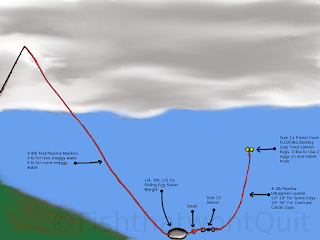
The rudimentary picture that you see to the right is the rig that I personally use anytime that I am still fishing for rainbow trout. It's very simple, but at the same time, very effective.
As far as the best bait to use when you are still fishing for trout, it's hard to go wrong with Berkley Powerbait or Berkley Power Eggs. Rainbow trout (especially trout that have been stocked) love these baits! The only difference that I've noticed between the two is that the eggs are easier to deal with and bait a hook with that traditional Powerbait. Although, if you are using a small treble hook (I suggest #12 or #18) traditional Powerbait is much easier to use, because you can just mold it around your hook creating a small ball of trout bait.
Once you have a rig such as the one pictured above baited up and ready it is cast out and allowed to sink to the bottom. Once on bottom, the slack line is slowly reeled in and your fishing rod is propped against a stationary object or rested on a forked stick or other rod holder. At this point, the still fishing begins.
Still fishing for rainbow trout means waiting for a hungry trout to bite your offering. My general "rule of thumb" is to wait 20-30 minutes and if there haven't been any bites, I reel and and re cast. If this happens more than 2 times, I change spots. And just in case you didn't know, when a hungry trout is biting your offering the tip of your rod will begin to bounce, at which time your gently pick up your rod and as soon as you feel weight, set the hook by lifting your rod straight back.
What was just outlined is the way in which I have caught hundreds of rainbow trout over the course of a couple of decades. Although very simple, the technique is very effective and because it has worked for me, I know it will be very effective for you as well anytime that you feel the need to head out fishing for trout.
Therefore, I figured it was a good idea to outline the personal method that I use to still fish for rainbow

The rudimentary picture that you see to the right is the rig that I personally use anytime that I am still fishing for rainbow trout. It's very simple, but at the same time, very effective.
As far as the best bait to use when you are still fishing for trout, it's hard to go wrong with Berkley Powerbait or Berkley Power Eggs. Rainbow trout (especially trout that have been stocked) love these baits! The only difference that I've noticed between the two is that the eggs are easier to deal with and bait a hook with that traditional Powerbait. Although, if you are using a small treble hook (I suggest #12 or #18) traditional Powerbait is much easier to use, because you can just mold it around your hook creating a small ball of trout bait.
Once you have a rig such as the one pictured above baited up and ready it is cast out and allowed to sink to the bottom. Once on bottom, the slack line is slowly reeled in and your fishing rod is propped against a stationary object or rested on a forked stick or other rod holder. At this point, the still fishing begins.
Still fishing for rainbow trout means waiting for a hungry trout to bite your offering. My general "rule of thumb" is to wait 20-30 minutes and if there haven't been any bites, I reel and and re cast. If this happens more than 2 times, I change spots. And just in case you didn't know, when a hungry trout is biting your offering the tip of your rod will begin to bounce, at which time your gently pick up your rod and as soon as you feel weight, set the hook by lifting your rod straight back.
What was just outlined is the way in which I have caught hundreds of rainbow trout over the course of a couple of decades. Although very simple, the technique is very effective and because it has worked for me, I know it will be very effective for you as well anytime that you feel the need to head out fishing for trout.
Monday, March 13, 2017
Is The Spring Of The Year The Best Time For Trout Fishing?
When I was learning how to fish for trout in Central Pennsylvania almost 30 years ago (good God the time really flies by) it was widely accepted that the spring of the year was the best time to fish for trout. After all, the spring is when the season started and coincided with the fish and game department stocking the lakes and rivers with literal truckloads of trout. So, I accepted the unwritten rule of the spring being the best time of the year to fish for trout and have lived by that moniker for most of my fishing career.
 And while this idea isn't necessarily untrue, I have since learned that for me and my fishing sensibilities, the fall has proven to be more productive when fishing for trout, especially when you are referring to large trout, which I define as trout that reach the 18 inch mark or longer. In any case, in many area's of the country, especially the Northeast United States, the spring of the year is a great time of the year for trout fishing, there's no doubt about it.
Nowadays I live in the western United States (Northwest Montana to be exact) and the spring is no doubt a great time of the year for trout fishing with one small caveat if you like to fish for spring trout in small rivers and streams like I do. Here in the west, if you want to have a successful outing trout fishing the small rivers and streams that I like you need to hit the water early. That means going trout fishing from mid March until late April, which is to say early spring.
And, just as you would probably imagine, this early spring trout fishing can be quite productive here in the Sweater United Sates. Right up until the point that the waters become to high and muddy due to snow melt in the mountains to drift fish effectively, which as you may or may not have gleaned is my preferred method when it comes to trout fishing? So, is the spring of the year the best time of the year for trout fishing? It sure can be and depending on the area that you live and fish and the method that use when you are out fishing for spring trout.
Saturday, February 20, 2016
It has been some time since I took the time to post anything on this blog, mainly because I had become disenfranchised about the whole idea. Why? Because at some point you begin to ask yourself, "what the heck is the point of this thing anyway?" I questioned the fact that any of this matters and became convinced that it didn't and no one read it anyway. So I stopped.
Then this morning, as the spring approaches, and the though of fishing for trout starts to come to the forefront of my mind, I thought about this blog and all of the information it contains. Then I thought about the fact that there are always new people that become interested in the subject of trout fishing and thought about how helpful this information could be to them if they were so inclined to read it. So i decided to begin adding to said information once again.
Will it matter this time? More than likely not, but who cares, right? I'm going to go ahead and do it for that person that's just getting into trout fishing or wants to take their trout fishing to "the next level" so to speak. And, seeing as how I'm a human being, if I become disenfranchised again, guess what? I don't have a terrorist holding a gun to my head making me do this, so I can stop again whenever I feel so inclined.
Sunday, May 31, 2015
A Different Way of Fishing The Run Off
As I have stated previously, at this time of the year the snow melts in the mountains as the weather warms, which fills mountains streams with water, which in turn fills area rivers with water. This is referered to as "run off" and it makes the river fishing that I love to do virtually impossible due to high/muddy water.
Well, there is a way that the run off can be used to you advantage when fishing and when a friend of mine invited me to go out on his boat and fish the Hungry Horse Reservoir I was introduced to a technique that I wasn't previously aware of. You see, as the mountains streams swell, full of "run off" water, that water obviuosly has to go somewhere and in the case of a reservior such as the one that we were going to be fishing, the water simply dumps into the reservior.
What I learned is that when this happens the trout that live in said reservoir will congregate in these area's to feast on the tasty morsels that the run off brings them. Also, at this time of the year the cutthroat trout in Hungry Horse Reservoir spawn, which means that salmon eggs are an excellent bait to employ. So I grabbed a jar of Pautzke's Balls O Fire salmon eggs, some small styrofoam floats, and we headed out.
Sure enough, by using a single # 10 hook, a split shot sinker on my line, and a small float about three feet up my line, we experienced some success. Within a couple of hours we caught 8 cutthroat and two rainbow trout between us. I mean sure, none of them were huge, with the biggest being about fifteen inches, but it was still a lot of fun. We were fishing where the dirty run off water met the clean reservoir water. It was enjoyable and a different way of fishing the run off to be sure.
Saturday, April 4, 2015
3 Tips That Will Help You Catch More Trout When Fishing With Powerbait
If you fish for trout you are undoubtedly aware of the trout bait known as "Powerbait", but did you know that this unique fishing bait is also available in options other than the trout bait that comes in little jars? Now don't get me wrong, I have been using traditional Powerbait to catch trout for more than twenty years and love the stuff, but the truth is that nowadays the line of Powerbait products is quite extensive and has value far beyond the world of trout fishing.
As a person who has been catching trout (mostly rainbow trout) with various Powerbait products for more than 20 years, below I will outline it by outline 3 tips that will help you catch more trout when you are using this unique type of trout bait. When added to your fishing arsenal, the tips will help you increase your catch rates anytime that you are using Powerbait to catch trout.
- The "Fresher" The Powerbait Product The Better - When you open any Powerbait product, whether it be the extruded trout bait or packaged "soft plastic" Powerbait, this is when it will be the most effective. Now does this mean that your bait needs to be replaced every fishing trip or two if it isn't used up? No, not at all, but with each new fishing season, any Powerbait product that you use should be replaced for maximum effectiveness. The longer the bait sits after being opened, the less effective it tends to become because of scent loss.
- Make The Focus Be The Bait - Many Powerbait products (such as Power trout worms, minnows, nymphs or eggs) are shaped just like live bait that they represent. This means that small fishing hooks or jigs should be used so that the focus of your offering is the bait and the scents that the bait is releasing into the water, rather than the fishing hook. If you want to fish with Powerbait and catch more fish, make sure that the fishing hooks or jigs that you use are as small as possible so that the focus of the offering is the bait.
- Fish When The Fish Are Most Active - This tip isn't limited to fishing with Powerbait and actually pertains to fishing with any type of bait, but fishing when the fish are the most active on a given day is as important as anything. So, how do you determine when the fish are going to be the most active? Simply by paying attention to things like the weather, the phase of the moon, and the moon rise and set and planning your fishing trip accordingly.
The bottom line is that these 3 simple tips will help you catch more fish anytime that you are fishing with the extremely effective bait known as Powerbait.
Sunday, March 22, 2015
Using A "Drop Shot" Rig When Fishing For Rainbow Trout
When fishermen think of the term "drop shotting" their attention almost always turns to bass fishing,
 and with good reason. The drop shot rig is one of the most effective bass fishing rigs of all time. So if a rig is effective for bass, why couldn't it be used when fishing for other species of fish? Well, it obviously can, and experienced anglers have been doing so for quite a long time. I have to admit, although I am an experienced angler, I tend to get "stuck it ruts" when it comes to my fishing, especially when it comes to my favorite species of fish the rainbow trout.
I've always unintentionally followed the premise, "if something works, why try something new?", and as arcane and hard headed as that it, for much of my fishing life (especially in the early days) it's how things were. Then a few years ago a colleague of mine started introducing me to new idea's and the rest was history. One of these idea's was using a drop shot rig when fishing for rainbow trout. When I saw him limit out one early afternoon a few years ago, I made sure that I took a mental notes on what it was that he was doing, and soon thereafter drop shot fishing became a part of my trout fishing arsenal.
I like to a seven or so foot long ultralight fishing rod when I am using drop shot rig for trout. By using a fishing rod with a little bit of length I am not only able to make longer cast, but it also makes it easier to add action to my worm by simply lightly shaking the tip of the rod.
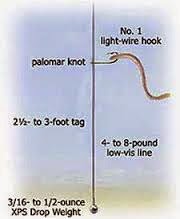
Using a drop shot rig when fishing for trout is primarily a "finesse" technique that seems to work best when other trout fishing tactics simply aren't producing. The rig itself is set up like this. First you will need a 2X or so light wire fishing hook with a turned down eye. The hook is threaded onto your line at least two feet and then the hook is tied to your line using a Palomar knot. When you are done with the knot you want to take your tag end of your line and thread the line back through the bottom end of the hook. The reason for this is to make the hook stick straight out from the line. Now a simple overhand knot is tied at the bottom of the tag end of your line at the depth you would like your worm to be above the bottom.This knot will act is a "stopper" for the split shot sinker that will now be pinched to the tag end of the tag end as your weight. This way when you cast your rig out your split shot wont go sailing off into the abyss. Now a floating trout worm is threaded onto your hook about 1/4 of an inch so that it sticks straight out from the hook (not like the worm in the picture above).
The baited rig is now cast out and allowed to sink to the bottom. Now reel in the slack line and slowly raise your rod tip, then shake the end of your rod as you reel, and repeat. Then recast and repeat so that you thoroughly cover the water that you are fishing. You will feel a tap, tap when a trout bites. You want to work the bait in a straight line back to you as you retrieve and try to keep the slack out of the line as much as possible. And remember, this is a finesse technique so don't work the rig too fast. Slower is better when it comes to using a drop shot rig for rainbow trout.
As you can imagine, drop shotting for trout is most effective in lakes are large pools in a river where there is little to know current flow. This "finesse" technique is very effective when trout fishing so make sure you add it to your trout fishing repertoire as soon as possible.
Sunday, March 15, 2015
How To Catch Hatchery Trout
In the spring of the year many people's attention turn to the act of fishing and a popular type of fish to target are trout. In many instances, such as in central Pennsylvania where I grew up, spring trout fishing meant that you were likely going to be targeting a specific type of trout called hatchery trout. Hatchery trout are just like any other trout, except that rather than being born in the wild they were born and raised in a fish hatchery and then released into the wild to be caught by anglers.

The bottom line is that hatchery trout usually aren't that difficulty to catch, especially when compared to a trout that was born and survived multiple seasons in a body of water, but that doesn't mean that you will can catch them no matter what you throw into the water. Below I will outline what I do to catch hatchery trout so that you can do the same thing. Believe me this little "how to" lesson certainly couldn't be compared to consistently catching Steelhead or anything else that is known to be difficult, but it is nonetheless effective and will enable you to catch a limit of hatchery trout the next time you head out in search of these fish.
Let's start with your rod, reel, and line. For the particular hatchery trout technique that I will outline, "still fishing" is the name of the game, so a fishing rod that is six to seven feet long is in order. Using a longer rod when fishing form the shore means that you will get a better and more effective hook set. The rod should also be ultralight power (often indicated by an UL) and I prefer fast action (which means the tip of the rod is pretty "stiff"). A matching reel should then be added to the mix and your reel should be spooled with line that's no heavier than six pound test mono filament.
Next there are three pieces of terminal tackle that you are going to need; a small barrel swivel, an egg sinker, and your choice of trout fishing hook. You can use a treble hook, a single bait holder fishing hook, salmon egg style hook, or a set of gang hooks. In the case of your fishing hook choice the only caveat is that your keep your choice small. In the case of salmon egg, bait holder or gang hooks don't go any larger than size 8 and in the case of treble hooks don't go any larger than size 12. When it comes to hatchery trout (or most any species of freshwater trout for that matter) remember, the smaller the better when it comes to your fishing hooks.
Now we have the rigs itself. Start by taking the end of your line and clipping off a 12-18 inch length of line for a leader and set it aside (the leader will be needed unless you are using gang hooks where this won't be necessary as they are made with the leader attached). Now slip one egg sinker onto your line and tie a small barrel swivel to the end of your line. This accomplished two things, it acts as a stopper for the sinker and it helps to prevent line twist by hooked trout. Finally the leader (or set of gang hooks) is tied to the opposite end of the barrel swivel and your fishing hook of choice is tied to the end of the leader.
That's your rig, now all you need to do is bait the hook and there is no more productive bait for hatchery trout in my experience than the trout bait known as Powerbait. Enough Powerbait is molded onto the hook so that the hook is completely covered and you are ready to go. If you prefer not to mold your bait onto your hook I have found that Powerbait Magnum Eggs are often just as effective (if not not more so) without all of the mess. This rig is now cast into the water and allowed to sink to the bottom. The slack line is then slowly reeled in until your line is completely taught. Now the "still fishing" begins. When the rod tip starts to bounce a hungry trout is biting your offering.
Sunday, March 8, 2015
Spring Trout Fishing - Drift Fishing With Meal Worms
As winter comes to an end and the spring begins to take over, for me it means one thing (other than
nicer, warmer weather of course) and that one thing is trout fishing. After the winter where most of my "trout fishing" is done while standing on a frozen lake, I can't wait to get out on the river and do a little drift fishing. Early in the spring, before the run off kicks into high gear, traditional drift fishing with live worms can be very productive.
However, once the river levels begin to rise, I have found that another bait is more productive when it comes to catching spring trout, meal worms. I would imagine that you are familiar with meal worms, but if not, they are the larval form of the meal worm beetle, which is a black beetle that you have no doubt seen before but wasn't aware of what it was. Well these little alien looking worms are quite effective when it comes to spring trout fishing.

Meal worms easily fit on a #10 or smaller fishing hook, are quite hearty, and are something that hungry spring trout like to gobble up when they are flowing with the current of the water in which they reside. Most convenience stores or bait shops will have live meal worms available, but if you can't find them or are squeamish about using them, the PowerBait Power Honey Worm is a more than viable substitute. As a matter of fact, I have a colleague who prefers the honey worm to a real meal worm anytime that he fishes for trout.
I like to utilize a basic drift fishing rig using # 10 gang hooks a barrel swivel and split shot sinkers when I am drift fishing meal worms, but a single hook can obviously be used if you prefer instead. I rig a meal worm onto each of the hooks, cast the rig into the river, and proceed to drift fish. I find that meal worms are most effective when the river is swollen and off color a little bit. Once the rivers become totally muddy, it becomes harder to get trout to bite, but before and after the heavy spring flow, I'm sure you will find meal worms to be an effective spring trout bait choice.
When drift fishing with meal worms in the springtime, I like to try to use my opposite hand to feel my line as the meal worm drifts downstream. The bite can often be hard to detect if you don't have a finger (or fingers) in contact with the line. When a finger is touching the line however, it is much easier to feel subtle bites from hungry trout.
nicer, warmer weather of course) and that one thing is trout fishing. After the winter where most of my "trout fishing" is done while standing on a frozen lake, I can't wait to get out on the river and do a little drift fishing. Early in the spring, before the run off kicks into high gear, traditional drift fishing with live worms can be very productive.
However, once the river levels begin to rise, I have found that another bait is more productive when it comes to catching spring trout, meal worms. I would imagine that you are familiar with meal worms, but if not, they are the larval form of the meal worm beetle, which is a black beetle that you have no doubt seen before but wasn't aware of what it was. Well these little alien looking worms are quite effective when it comes to spring trout fishing.
Meal worms easily fit on a #10 or smaller fishing hook, are quite hearty, and are something that hungry spring trout like to gobble up when they are flowing with the current of the water in which they reside. Most convenience stores or bait shops will have live meal worms available, but if you can't find them or are squeamish about using them, the PowerBait Power Honey Worm
is a more than viable substitute. As a matter of fact, I have a colleague who prefers the honey worm to a real meal worm anytime that he fishes for trout.I like to utilize a basic drift fishing rig using # 10 gang hooks a barrel swivel and split shot sinkers when I am drift fishing meal worms, but a single hook can obviously be used if you prefer instead. I rig a meal worm onto each of the hooks, cast the rig into the river, and proceed to drift fish. I find that meal worms are most effective when the river is swollen and off color a little bit. Once the rivers become totally muddy, it becomes harder to get trout to bite, but before and after the heavy spring flow, I'm sure you will find meal worms to be an effective spring trout bait choice.
When drift fishing with meal worms in the springtime, I like to try to use my opposite hand to feel my line as the meal worm drifts downstream. The bite can often be hard to detect if you don't have a finger (or fingers) in contact with the line. When a finger is touching the line however, it is much easier to feel subtle bites from hungry trout.
Saturday, February 28, 2015
You've Tried Berkly Power Eggs, Right?
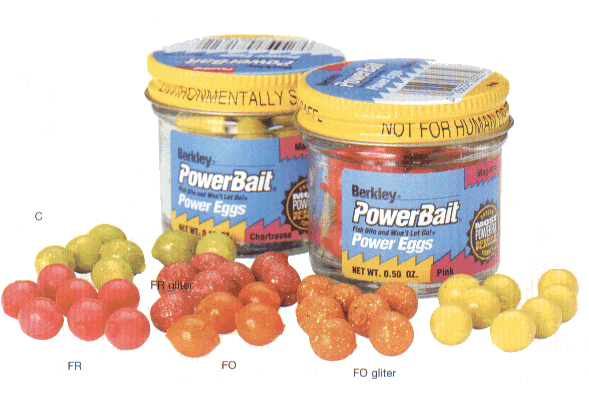 For many years I have been using Berkley Powerbait to catch stocked trout. There are plenty of posts using Powerbait to catch trout throughout this blog for because this particular trout bait is so darned effective when you are fishing for rainbow trout that have been planted into a body of water. But the other day I was introduced to another form of Powerbait that for some strange reason had not been on my radar for all of these years? Actually it's probably due to the fact that because the dough style of Powerbait has always resulted in success, so I had never tried to investigate the situation any further. You know, the "path of least resistance" rule?
In any case, due to one of my colleagues (whom I hadn't seen in quite a long time until the other day when we got a chance to wet a line) I am now abundantly aware of Power Eggs and I couldn't be happier. These little buggers are great! All of the trout attracting power of the Powerbait dough bait that we are all so familiar with, but power eggs have a couple of unique distinctions. The most important in my estimation is that Power eggs are much more durable and easy to use than the dough style Powerbait.
Power eggs come in the same variety of colors as the dough style trout bait that we are all so familiar with, but stay on the hook much longer than you are probably used to. As you are no doubt aware, traditional Powerbait becomes slimy and disintegrates in the water after a period of time (30 or so minutes in my experience) and comes off of the hook fairly easily for a variety of other reasons as well. Well this is not the case when it comes to the much more durable Power eggs. These unique fishing eggs stay on the hook, even after multiple bites. My colleague actually caught 3 trout from 10-13 inches the day we were out fishing, without having to put on a new Power Egg! I can promise you that nothing like this ever happens when traditional Powerbait is being used as bait. I mean sure you'll catch trout, but you'll be re baiting after every caught trout.
The bottom line is that if you use dough style Powerbait when fishing for trout, do yourself a favor and give Power eggs a try the next time you head out trout fishing. You may never buy the dough bait again? Power eggs are just as effective, without all the hassle of the traditional version of Powerbait.
Monday, February 16, 2015
A Trout Fishing Technique That You May Have Never Heard Of
 It's no secret, at least not to us, that crayfish are as effective a trout bait as there is when it comes to fishing for trout. We always have a small crayfish crank bait or two in our fishing vest, but we end up utilizing them much less often than we probably should. And we have and do use live crayfish as bait for trout from time to time, but not as often as we would like due to how much of a pain in the butt it is.
But recently we were introduced to a trout fishing technique involving this extremely effective trout bait that we weren't previously aware of. In hind site this isn't quite true as we like to utilize a small jig head and a Powerbait mini craw as bait for whitefish on the Flathead river, but for some strange reason never put two and two together? The technique involves something called the Trout Slayer
and is as effective a trout fishing bait and technique as we have come across in quite a while. What is the Trout Slayer you ask? Well, it's simply a mini jig head (1/64 oz.) and a tiny soft plastic crayfish that you thread onto the shank of your hook. This jig is then drift fished with the current of the river or stream in which you are fishing or bounced along the bottom if you are fishing in a lake or pond for trout.At this point you are probably saying to yourself something to the effect if, "how in the heck am I going to cast a jig that small and there is no way that little thing is going to stay anywhere near the bottom", and you would be exactly right! Without using a really long ultralight fishing rod (which some trout fishermen do choose to employ) casting and retrieving a jig head that is this small can be very difficult. However, this problem in remedied by simply placing a 12-18 inch leader to your line by using a small barrel swivel and attaching your jig head to the end of the leader. This way split shot sinkers can be added to your line (above the swivel) for weight, which makes the entire rig much easier to cast and retrieve, while keeping the bait on or very near the bottom.
In order to implement this particular trout fishing technique, the rig is cast into the water, either in a lake or across the current of a river, and allowed to sink to the bottom. The trout slayer is then worked along the bottom, varying the speed of your retrieve, to imitate a crayfish working it's way along the bottom. Keep the tip of your rod close to the water so that your slayer stays close to the bottom. As I said you are imitating a small crayfish, and they stay as close to the bottom as much as possible.
Hungry trout will readily gobble up a little crayfish whenever they can, so be ready. We have found that low light conditions, like morning, evening, or cloudy days seem to be the most effective when it comes to fishing the trout slayer
. But, truth be told, most trout will snatch up a crayfish anytime they get the opportunity, but during low light conditions we seem to catch larger trout that we do at other times.
Monday, February 9, 2015
How To Set Up For Trout Fishing With Powerbait
One of the easiest and most popular
ways to catch a rainbow trout or two is by fishing with Powerbait.
Powerbait and below I will outline how to set up
for trout fishing with this unique type of trout bait. It is a set
up that I have used successfully for more than twenty years.
 Powerbait is an extruded dough bait that has been specifically
designed to attract hungry trout and in my experience is quite
effective. Every fishing season rainbow trout that have been raised
in hatcheries are then released into waterways throughout the country
for the express purpose of being caught by anglers. I have found
that these trout are especially susceptible to being caught with the
trout bait known as
and below I will outline how to set up
for trout fishing with this unique type of trout bait. It is a set
up that I have used successfully for more than twenty years.
Although stocked trout (rainbow trout
that have been raised in a hatchery environment) definitely aren't
the most cunning creatures on the planet, they do share DNA with
native rainbow trout and therefore should be treated with some level
of respect, even though they often aren't. Let's begin with the
fishing line that your fishing reel is spooled with. The biggest
mistake that most people make when trout fishing, no matter what type
of trout bait they are employing, is to use line that's too heavy. I
don't want you to make that mistake, so make sure that the fishing
line that your reel is spooled with is no heavier than six pound
test, with four or even two pound test being the ideal type of line
to use when you are trout fishing with Powerbait.
Next we have the type of trout fishing
hooks that are being used. Most people who trout fish with Powerbait
opt to use a single treble hook. Others opt to use a single shank
fishing hook or a set or gang hooks (which is simply a pair of single
shank fishing hooks which have been tied back to back). The key when
it comes to the fishing hooks that are used when fishing with Powerbait is that said fishing hooks are small.
Single shank hooks should be #10 or smaller and treble hooks should
be #12 or smaller.
Next we have the actual set up that
will be used when you are fishing for trout. Start by grabbing the
end of your line and cutting off a twelve to twenty four inch length
of line. This will be your leader (which can be whatever length you
prefer) and you can simply set this aside for now. Now slip a small
egg sinker onto your line and tie a small barrel swivel to the end of
the line. This will act as a 'stopper' for the sinker a well as
giving you a place to tie your leader to. Now tie the leader that
you just made to the other end of the barrel swivel and your fishing
hook to the end of the leader.
You will notice that your set up now
has your hook with a sinker that “floats” freely on the line.
This is great because when an inquisitive trout bites your Powerbait
they will feel no resistance from the sinker, it will be a “direct
shot” to your rod tip. The hook is now covered completely with
Powerbait and your rig is complete. This is an extremely effective
way to set up for trout fishing with Powerbait. The rig is now cast
into a lake, allowed to sink to the bottom, and “still” fished
until a hungry rainbow trout detects and begins to bite your
offering.
Sunday, November 2, 2014
Fall Trout Fishing: Making The Best Of A Rainy Situation
Although fishing for trout in the fall of the year can be a very productive endeavor, the weather can be unpredictable to say the least. One day it's beautiful, the next it's cold and rainy with the threat of winter looming over the situation like a father over his 15 year old daughter when she shows up an hour late after her first "party". This is exactly the situation that I find myself in today.
It's cold and rainy, the type of day no one in their right mind would want to spend on the water chasing trout, however I have never claimed to be in my right mind. I am acutely aware of the fact that November is officially upon us and that I have very little time left in the year to fish for trout, so it is of the utmost importance that I spend as much time on the water trout fishing as I can, while I can, because soon it will be too cold to spend very much time at all on the river that I love so much.
Therefore I have a plan. I have checked the weather forecast and the radar map on the interweb (technology is a wonderful thing) and have determined that the rain should stop at around 3:00 for six or seven hours? Is this an idea that I should be confident about? Probably not because I know how unpredictable the weather actually is, but a girl can dream can't she? In any case, I'm planning on giving fishing a shot at around 3:00 this afternoon and we'll see what happens. One thing I do know is that the temperatures aren't supposed to even hit the 40 degree mark today, so a pair of Wristies will be on my hands no matter what. This is without a doubt the kind of day that fingerless fishing gloves were made for.
Sunday, October 26, 2014
Before We Know it The Fall Trout Fishing Season Will be Gone For Another Year
Every time that I've had the opportunity to hit the river this fall the, the rainbows have been hungry, which makes me happy and sad at the same time. Happy because catching rainbow trout (especially ones that are over the 15 inch mark) is as enjoyable to me as any activity on this planet and sad because each morning I notice the temperatures dropping, which means that my days of productive drift fishing are numbered.
So, since I know that fall fishing will be over soon, that means that I need to hit the river as much as I can in the next four weeks or so. Which is exactly what I did last weekend when I managed to catch and release five nice, healthy rainbow trout that measured between fifteen and twenty inches. And I had one hooked that felt at least as big as my largest trout of the day, only to break my line during the battle. Yep, the fall trout season is certainly in full swing and I for one am taking advantage of it as much as possible before it's gone for another year.
So, since I know that fall fishing will be over soon, that means that I need to hit the river as much as I can in the next four weeks or so. Which is exactly what I did last weekend when I managed to catch and release five nice, healthy rainbow trout that measured between fifteen and twenty inches. And I had one hooked that felt at least as big as my largest trout of the day, only to break my line during the battle. Yep, the fall trout season is certainly in full swing and I for one am taking advantage of it as much as possible before it's gone for another year.
Subscribe to:
Posts (Atom)